PCOS Pathophysiology
Written by: Dr. Muhammad Ihsan Ullah, PhD
Medically reviewed by: Dr. Hafiz Muhammad Kashif, MD
Last updated on February 04,2026
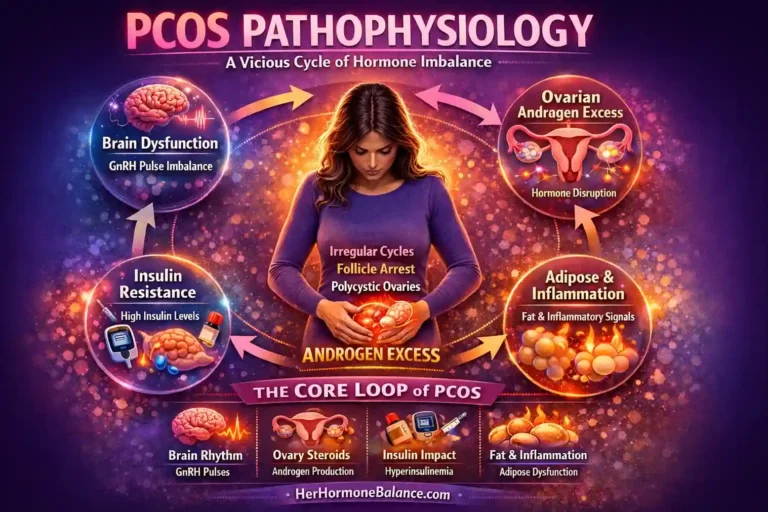
PCOS (polycystic ovary syndrome) is not “one problem.” It’s a self-reinforcing network where the brain, ovaries, insulin system, and fat tissue keep amplifying each other until the body gets stuck in a pattern of androgen excess, ovulatory dysfunction, and often polycystic ovarian morphology. That network also explains why PCOS can look very different from one person to another (Dong, J., & Rees, D. A. 2023).
The “Core Loop” Behind PCOS Pathophysiology
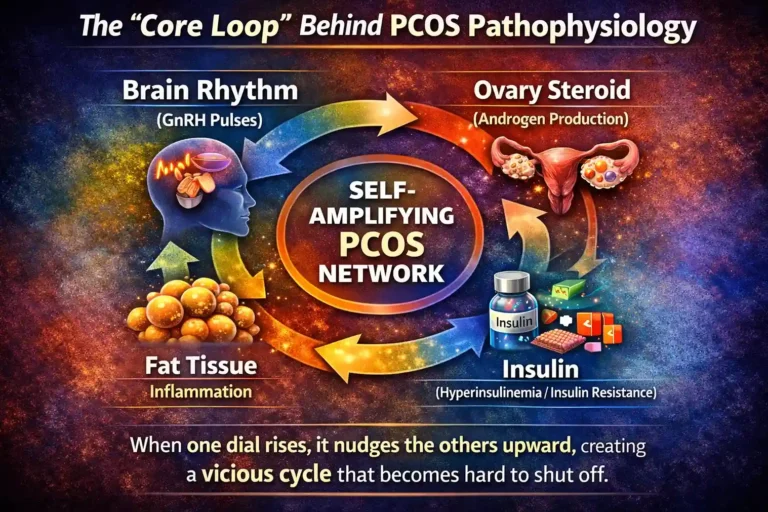
Imagine four dials that affect each other:
- Brain rhythm dial (GnRH pulses)
- Ovary steroid dial (androgen production)
- Insulin dial (hyperinsulinemia / insulin resistance)
- Fat tissue & inflammation dial (adipose dysfunction)
When one dial rises, it nudges the others upward creating a vicious cycle that becomes hard to shut off (Dong, J., & Rees, D. A. 2023).
1) Neuroendocrine “Rhythm Disorder”: GnRH Pulse Generator Overdrive (HPO Axis)
Your reproductive system runs on a pulse signal from the brain:
- The hypothalamus releases GnRH (gonadotropin-releasing hormone)in pulses.
- The pituitary answers with LHand FSH
- The ovary interprets that pattern to decide: build follicles, ovulate, and balance steroid hormones.
In PCOS, the system often shifts into high-frequency GnRH pulsatility. This matters because fast GnRH pulses tend to favor LH secretion over FSH, biasing the ovary toward androgen production and away from normal follicle maturation (Dong, J., & Rees, D. A. 2023), (Moore, A. M. 2025).
The upstream “controllers”
Researchers highlight a control network in the hypothalamus KNDy neurons (kisspeptin, neurokinin B, dynorphin) as key regulators of GnRH pulse generation. In PCOS, dysregulation in this upstream signaling contributes to abnormal pulse patterns (Dong, J., & Rees, D. A. 2023), (Moore, A. M. 2025).
2) LH–FSH Imbalance: How the Ovary Gets Pushed Toward Androgens
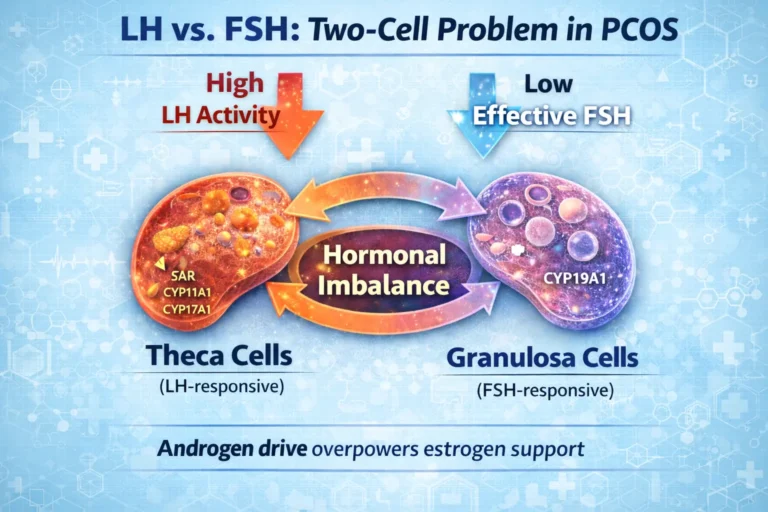
The two-cell problem
A healthy follicle relies on teamwork:
- Theca cells(LH-responsive): make androgen precursors.
- Granulosa cells(FSH-responsive): convert androgens to estrogens via aromatase (CYP19A1).
In PCOS-type signaling, relatively higher LH activity plus relatively lower effective FSH support can lead to:
- More theca-cell androgen synthesis
- Less granulosa-cell aromatization efficiency
- A hormonal environment where follicles struggle to fully mature
This is one reason PCOS is often described as functional ovarian hyperandrogenism the ovary becomes “biased” toward androgen output (Dong, J., & Rees, D. A. 2023).
- StAR (steroidogenic acute regulatory protein): moves cholesterol into mitochondria
- CYP11A1: converts cholesterol → pregnenolone (first committed step)
- CYP17A1: key enzyme driving androgen precursor formation
- AKR1C3 / HSD3B2 / HSD17B enzymes: conversions within androgen pathways
- CYP19A1 (aromatase)in granulosa cells: converts androgens → estrogens
These aren’t random enzyme names they explain why the ovary becomes an androgen factory under certain signals (Dong, J., & Rees, D. A. 2023).
3) Insulin as a “Co-Gonadotropin”: Hyperinsulinemia Amplifies Ovarian Androgen Output
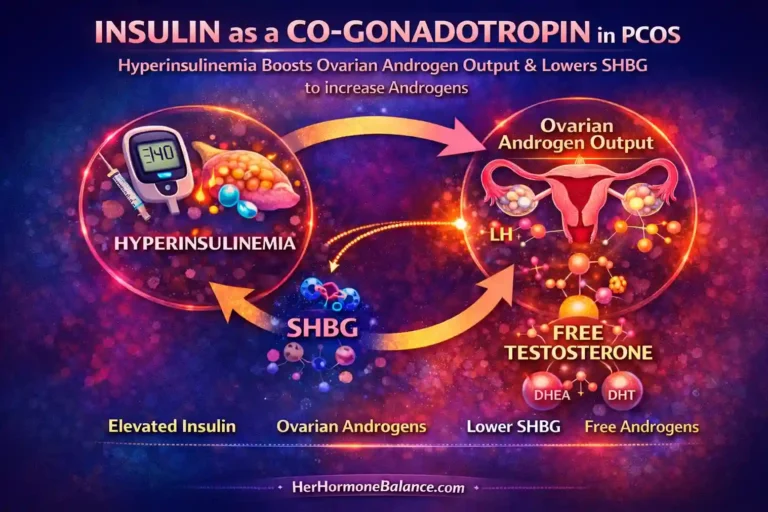
If PCOS had one metabolic amplifier, it would be hyperinsulinemia high insulin levels (sometimes with insulin resistance, sometimes not in the same sequence for every person).
Insulin works synergistically with LH to increase ovarian androgen production and simultaneously reduces hepatic SHBG (sex hormone-binding globulin)—which increases the fraction of free (bioactive) androgens (Houston, E. J., & Templeman, N. M. 2025).
That’s why insulin is often described (functionally) as a co-gonadotropin in PCOS physiology—even though it’s not a reproductive hormone.
- The classic model: insulin resistance → compensatory hyperinsulinemia
- A competing model in subsets: hyperinsulinemia may come earlier, then contribute to insulin resistance and androgen excess
This isn’t “internet controversy.” It’s a real mechanistic discussion in recent endocrine literature (Houston, E. J., & Templeman, N. M. 2025).
4) The Androgen Amplifier System: Ovarian + Adrenal + Peripheral Androgens (Including 11-Oxygenated Androgens)
Many people think “testosterone = the whole story.” PCOS is broader.
A modern concept increasingly emphasized: 11-oxygenated androgens can be highly relevant, and are increasingly discussed as markers linked to metabolic risk in PCOS biology (Dong, J., & Rees, D. A. 2023).
Why this matters mechanistically
Even if the ovary is the main driver, androgens also:
- Change fat distribution and adipose signaling
- Influence insulin biology
- Affect neuroendocrine feedback loops (brain-ovary signaling)
That’s how PCOS becomes a self-reinforcing endocrine state, not a single-organ disease (Moore, A. M. 2025).
5) Follicle Arrest: Why Many Follicles Start… and Then “Pause”
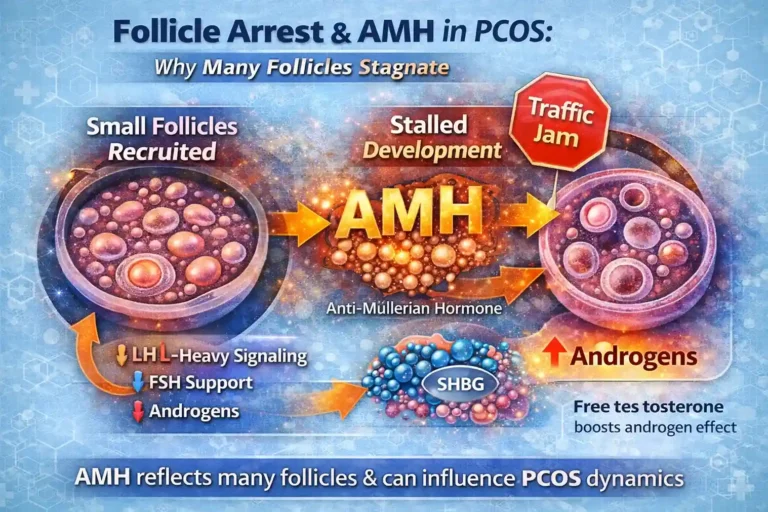
The “traffic jam” model
In PCOS, follicles often recruit, grow to small antral stages, and then stall creating the classic “many small follicles” appearance.
Several forces can push toward follicle arrest:
- LH-heavy signaling environment
- Relative functional FSH deficiencyat the follicle level
- Androgen-dominant microenvironment
- Anti-Müllerian hormone (AMH)effects on follicle dynamics and central signaling
Recent neuroendocrine reviews also discuss AMH as more than a marker AMH may interact with central reproductive signaling and follicle physiology in ways relevant to PCOS biology (Moore, A. M. 2025).
6) Impaired Hormone Feedback: Why the System Doesn’t “Self-Correct”
In many endocrine systems, the body stabilizes itself through negative feedback. In PCOS physiology, multiple feedback points can weaken:
- Progesterone negative feedbackon GnRH/LH pulsatility may be impaired
- Androgen and metabolic signals can alter central responsiveness
- This helps keep the GnRH pulse generator “biased” toward high frequency
This helps explain why PCOS can persist even when a person tries lifestyle changes—because the neuroendocrine rhythm can remain abnormal until multiple parts of the loop shift together (Moore, A. M. 2025).
7) Adipose Tissue Dysfunction: More Than “Weight”
A common misunderstanding is that fat tissue is just storage. In endocrine reality, adipose tissue is a hormone-active organ.
In PCOS pathophysiology, adipose biology can contribute through:
- Altered adipokines (e.g., adiponectin-related signaling)
- Low-grade inflammation pathways
- Changes in lipid handling and insulin signaling
This is one reason PCOS can carry cardiometabolic risk even when symptoms feel “reproductive” (Dong, J., & Rees, D. A. 2023).
8) Gut–Metabolic Signaling and PCOS: A Supporting Axis (Not the Main Driver)
You’ll see gut microbiome claims online that are wildly overstated. The responsible, evidence-aligned way to say it:
- Gut and enteroendocrine changes are being studied as contributing mechanisms
- They may influence insulin biology, inflammation, and metabolic signaling
- They are not proven to be the single “root cause” of PCOS
Modern reviews include gut microbiome changes among the mechanistic advances shaping current PCOS models (Dong, J., & Rees, D. A. 2023).
9) Genetics, Epigenetics, and Developmental Programming: Why PCOS Is So Heterogeneous
PCOS is frequently described as polygenic susceptibility interacting with environmental and developmental influences.
That matters because it helps explain:
- Why two people can meet criteria but have very different metabolic profiles
- Why some develop prominent insulin resistance while others don’t
- Why the same “label” can hide different biology underneath
This polygenic + environment framework is explicitly highlighted in major pathophysiology reviews (Dong, J., & Rees, D. A. 2023).
10) A New Mechanistic Clue From 2024: CYP11A1 Control and Hyperandrogenism
A 2024 Science paper reported that artemisinin derivatives can suppress ovarian androgen synthesis by promoting CYP11A1 protein degradation via a LONP1–CYP11A1 interaction, lowering hyperandrogenemia in models studied (Liu, Y., et al. 2024).
It highlights how upstream control of steroidogenesis enzymes can change the androgen state—supporting the idea that PCOS is, in part, a disorder of steroidogenic regulation, not just “high testosterone.”
11) Mechanism → What It Creates
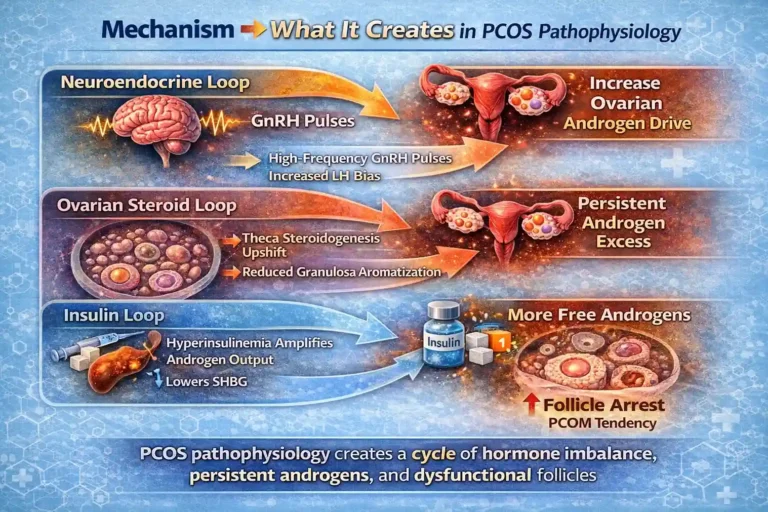
Neuroendocrine loop
- High-frequency GnRH pulses→ LH bias → increased ovarian androgen drive (Dong, J., & Rees, D. A. 2023).
Ovarian steroid loop
- Theca steroidogenesis upshift+ reduced granulosa aromatization → persistent androgen excess (Dong, J., & Rees, D. A. 2023).
Insulin loop
- Hyperinsulinemiaamplifies androgen output + lowers SHBG → more free androgens (Houston, E. J., & Templeman, N. M. 2025).
Follicle dynamics loop
- Androgen-dominant environment + altered gonadotropin pattern→ follicle arrest and PCOM tendency (Moore, A. M. 2025).
Medical Disclaimer
This article is educational and explains biological mechanisms. It does not replace clinical evaluation, diagnosis, or individualized medical care.
Frequently Asked Questions(FAQs)
1) What does “PCOS pathophysiology” mean in simple terms?
It means how PCOS works inside the body—how hormone signals and metabolism interact and keep the system stuck.
2) Why is LH often higher in PCOS?
Because the brain’s hormone pulse rhythm can speed up, which tends to push the pituitary to release more LH compared to FSH.
3) How does insulin raise testosterone in PCOS?
High insulin can boost ovarian androgen production and reduce SHBG, which increases the amount of free (active) androgens in the body.
4) What is “follicular arrest” in PCOS?
It means many follicles start developing but pause early, so fewer reach full maturity and ovulation becomes harder to complete.
5) Are “PCOS cysts” real cysts?
Usually not. They are typically many small immature follicles seen on ultrasound, not dangerous cysts.
6) Why is AMH often high in PCOS?
Because AMH reflects the number of small growing follicles, and PCOS often has more follicles stuck in that stage.
7) Why does PCOS look different from person to person?
Because different internal pathways can dominate—brain hormone rhythm, insulin/metabolic signals, and inflammation/adipose signaling—so the same condition can show different patterns.
References
- Teede, H. J., Tay, C. T., Laven, J. J. E., Dokras, A., Moran, L. J., Piltonen, T. T., Costello, M. F., Boivin, J., Redman, L. M., Boyle, J. A., Norman, R. J., Mousa, A., Joham, A. E., & International PCOS Network. (2023). Recommendations from the 2023 international evidence-based guideline for the assessment and management of polycystic ovary syndrome. European Journal of Endocrinology, 189(2), G43–G64. https://doi.org/10.1093/ejendo/lvad096
- Dong, J., & Rees, D. A. (2023). Polycystic ovary syndrome: Pathophysiology and therapeutic opportunities. BMJ Medicine, 2(1), e000548. https://doi.org/10.1136/bmjmed-2023-000548
- Moore, A. M. (2025). Neuroendocrine mechanisms responsible for elevated gonadotrophin-releasing hormone and luteinising hormone pulses in polycystic ovary syndrome. Journal of Neuroendocrinology, 37(8), e70028. https://doi.org/10.1111/jne.70028
- Houston, E. J., & Templeman, N. M. (2025). Reappraising the relationship between hyperinsulinemia and insulin resistance in PCOS. Journal of Endocrinology, 265(2), e240269. https://doi.org/10.1530/JOE-24-0269
- Liu, Y., Jiang, J.-J., Du, S.-Y., Mu, L.-S., Fan, J.-J., Hu, J.-C., Ye, Y., Ding, M., Zhou, W.-Y., Yu, Q.-H., Xia, Y.-F., Xu, H.-Y., Shi, Y.-J., Qian, S.-W., Tang, Y., Li, W., Dang, Y.-J., Dong, X., Li, X.-Y., Xu, C.-J., & Tang, Q.-Q. (2024). Artemisinins ameliorate polycystic ovarian syndrome by mediating LONP1–CYP11A1 interaction. Science, 384(6701), eadk5382. https://doi.org/10.1126/science.adk5382